2019 update – I note that they haven’t changed the rules, so the below still applies. Disappointing. Not even bothering to write a new post this year.
__________
 The Sunday Star Short Story Contest is an established New Zealand contest. For the most part it’s run annually. With the disappearance of The Katherine Mansfield Short Story Award, the Sunday Star is now, as far as I can tell, the major New Zealand short story contest. And one of few that does not ask entrants for an entry fee.
The prize is substantial. $1000. For a 3000 word (maximum) story. That’s about thirty-three cents a word. Getting into the non-fiction per word payment range. Pro-fiction rates get up around ten cents a word, mostly around six to eight cents.
That tells me I should enter.
I’ve been long-listed for the contest in the past. My writing’s getting better. I’m losing eligibility for other contests because of my pro/almost-pro status.
So I wrote a story. I’m pretty pleased with it. I got it proofed and ready to go.
I went to the site to enter. That’s easy. Fill out the form, attach the document, click the ‘enter’ button. By entering I agree to the rules.
You know those sites we sign up for and we tick the box to accept the terms and conditions? Some of those documents are massive. We put our trust in them. Mostly that’s just fine.
Anyway, I decided I should read the rules. Really there were only eighteen. A little more than a page. Compared to some of those ‘terms and conditions’ documents, nothing more than an eye blink.
In the past the Sunday Star Times Short Story Contest. offered prizes to the first, second and third place-getters. Now, it’s just one prize. That’s okay. Things change.
– Open to permanent residents only. Check.
– Maximum of 3000 words. Check.
– Maximum of one entry per category. Check.
– Original work. Check.
– The finalists’ names, entry details, biographical information and photographs will be required by Fairfax Media and will be used for promotional purposes without compensation. You consent to this use of your details by entering the competition and agree to your name being published without notification or prior approval.
Uh. Hold on. “Without compensation”? Oh well, I suppose that’s all good promotion. Name and photo in the paper, if I happen to be a finalist. Nice for the ego and so on.
Okay. On with the rules.
– All entries submitted remain the property of the entrant. However (my italics), Fairfax Media and Penguin Random House New Zealand have the right to publish the winning and highly commended manuscripts of the Open Division, Secondary School Division and Non-Fiction Essay entered without fee. (my bolding).
What? “Without fee”? Really? So that amounts to: If I enter they’ll be able to publish my story without paying me.
It does say ‘winning and highly commended’, but it doesn’t say what constitutes highly commended. From my point of view anyone who gets it together to write a story and send it off should be highly commended. It takes courage and effort. Well done. If that’s the criteria, then any and every entry could qualify for publication ‘without fee’. Oh, except for the winning entry.
While I’m having a rant; right now there’s a New Zealand magazine that publishes a short story each month. As I understand it they take a vote or something at the end of the year and choose a winning story from those twelve and give that writer a prize. The other eleven do not receive anything save publication. I’m not even clear that they get copies of the issue in which they were published. Effectively those stories appear ‘without fee’.
This is why I didn’t enter. Writers get paid. The journalists in the paper and magazine who write the articles about the treaty and the housing crisis and climate change all get paid.
And that’s why I didn’t enter. That story I wrote? I’ll be sending that off to a paying market.
 So, as well as tracking my word count this year, I’ve also tracked my number of submissions. Now, I do keep close track of where and when I’m submitting (it would be kind of silly not to), but this is the first time I’ve ever recorded the actual number as well.
 My friend Tom Carpenter has a new story
  Aussie SF Snapshots takes a quick look at the Australian SF community with a series of incisive interviews. I was fortunate enough to be interviewed by the esteemed
  To round out a busy month of publications, my story “Ink for a Verbal Contract” is out now and available to read for free in
  With my recent publication in
 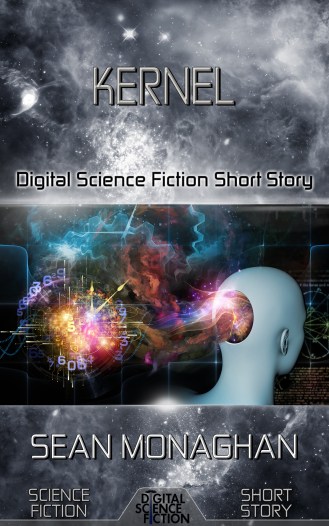 My short story ‘Kernel’ has just been published as a standalone by
  My short story “Go For The Dome” is out now in the August issue of
 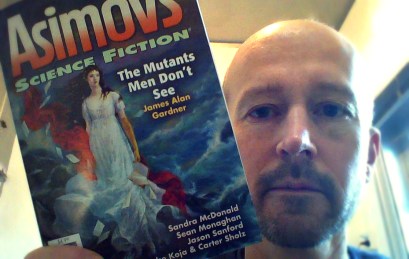 Finally my subscriber’s copy arrived! That’s a smile on my face, I’m sure. Clearly too focused on working the new computer’s camera… but inside I’m smiling, and jumping up and down and turning cartwheels. Well, at my age, I can manage one cartwheel 🙂
 My story “Wakers” is out now in the August issue of
  Triple V Publishing