After all those noes, a yes.


It’s worth sticking with it. I’ve lost count of the rejection slips I’ve received this year. Give me a second, I’ll go check…

… back now, thanks for waiting. It’s fifty-four. 54 rejections so far in 2012. That’s from around 25 stories out and circulating. I’ve had a few acceptances, but mostly for non-pay* or token pay anthologies/magazines. Most days when I get a rejection, the story goes out to another publisher the same day. I love these days of email submissions: so much easier than back in the dark ages of envelope, stamp, return envelope and postage, printed cover letter, fresh print of the ms because the last publisher crumpled their copy.

Why send it out again ever? Well, publishers have different opinions, different needs and different expectations. On occasion some particularly generous (ie who has the time?) editors give some feedback… and the feedback can be wildly different: the aspects of the story they found didn’t work will be entirely different. I also keep trying to remember that last of Heinlein’s rules – keep it on the market until it is sold.

The new acceptance is from a New Zealand literary magazine – Takahe – who’ve published stories of mine before. It will be nice to be in print again.

*Why take no money for a story? That’s kind of contradictory to good business sense, no? Well I guess part of it is my ego is still tangled up in there. Another part of it is that when I come to self-publish the story through Triple V as an ebook (and possibly print), then the rights revert to me immediately.

Lucy Snyder – on sales versus publications

I’ve had Lucy A. Snyder’s slim collection Installing Linux on a Dead Badger on my shelf for a couple of years, always meaning to get on to reading it. From the title you can tell it’s pretty tongue in cheek, and it is. From sly snickers to laugh-out-loud moments I really did enjoy the collection. Some of the stories are told in fairly standard narrative, while others are written as news reports. There’s a thread running through the book – the whole Linux as a way to work with the undead, and similar ideas – which makes it a strong unifying whole.

This prompted me to check out her website, and Lucy’s been busy since (and before) publishing the badger book – several books from Del Ray, which I’ll be checking out.

That all leads me to the point of my post – Lucy’s cool post “On sales versus publications” about why she lists her story sales, rather than her publications. Go read the post. Okay, it’s a few years old now, but the concept still stands. It’s been argued elsewhere – along the lines of treating writing like any job, a writer deserves to be paid – but Lucy gives a great and concise argument.

You’ll see in my bibliography I list publications. Just a handful of those are genuine sales, and many of those for token amounts.

First try at publishing a double-header


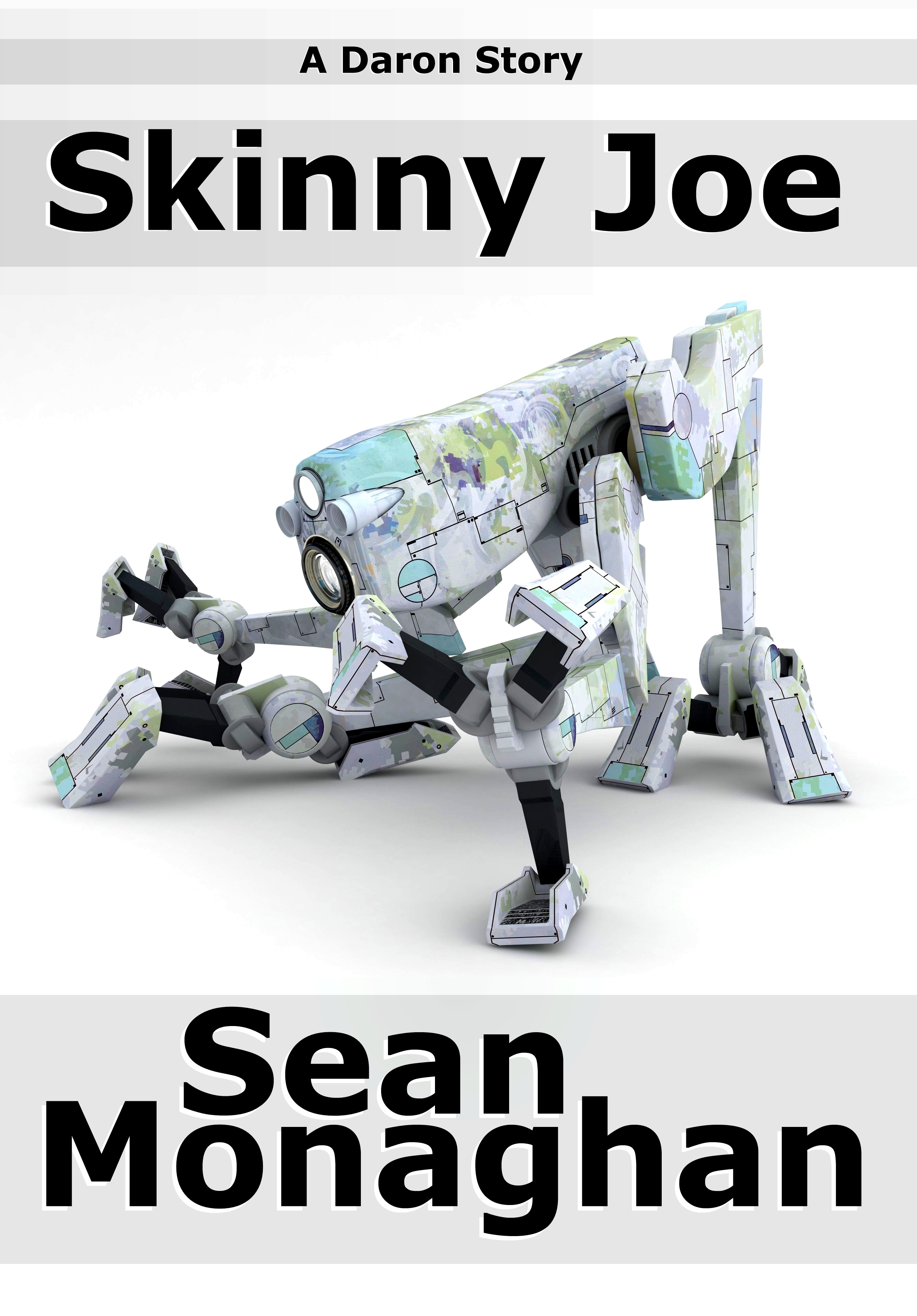
As my self-publishing empire lags and stutters along, I’ll keep trying new things. What a learning curve. Following ideas from Dean Wesley Smith and Kristine Kathryn Rusch with their publishing arm WMG Publishing I’ve published two stories – Pipe Dive and Skinny Joe together, as one package, but as two separate units one with each story as the lead title. The content of each is the same, just in reversed order. They are linked stories – both set on the same world, with the same group of researchers (though in these two stories there’s no character crossover, there are, and will be, in other stories).

As you can see, I’m also working with covers – one is self-designed, the other is a commercial/professional illustration. I’ve bumped up the font size and word layout while trying to retain the general Triple V Publishing look. I noticed on some covers (like Xuento), the author name almost vanishes. Spreading “Monaghan” across the width, then tucking “Sean” in above, nestled between the “M” and the “h” risers makes the name visible at even thumnail size. I’ve simplified the covers too – no tagline, not even the Tripe V logo (perhaps that’s a mistake, we’ll see).

I’ve worked on my blurbs too – trying to be active and succinct. I think next year I’ll look at taking Dean Wesley Smith’s course on writing pitches and blurbs. This is how they look at the moment:

Skinny Joe
A Daron story. Skinny Joe’s on a deadline. And he can’t wait to get home to see Paula. But when he triggers something in the depths of the structure, it looks like he’ll be lucky to get out alive. A short story by Sean Monaghan, author of The Tunnel and Rotations. Includes bonus story “Pipe Dive”.

Pipe Dive
A Daron story. Pieter thought divorcing Mel would have been the end of it. Now he’s trapped in an artificial cavern deep in the structure. With Mel. And there’s no way to get back. A short story by Sean Monaghan, author of The Tunnel and Rotations. Includes bonus story “Skinny Joe”.

Buy them here: Skinny Joe and Pipe Dive. Soon on Kindle, B&N and so on.

Skinny Joe was originally published in Infinite Windows, and this is the first publication of Pipe Dive. That’s a new experiment – most of the Sean Monaghan fiction I’ve self-published has been of previously published works.

Moving the goalposts

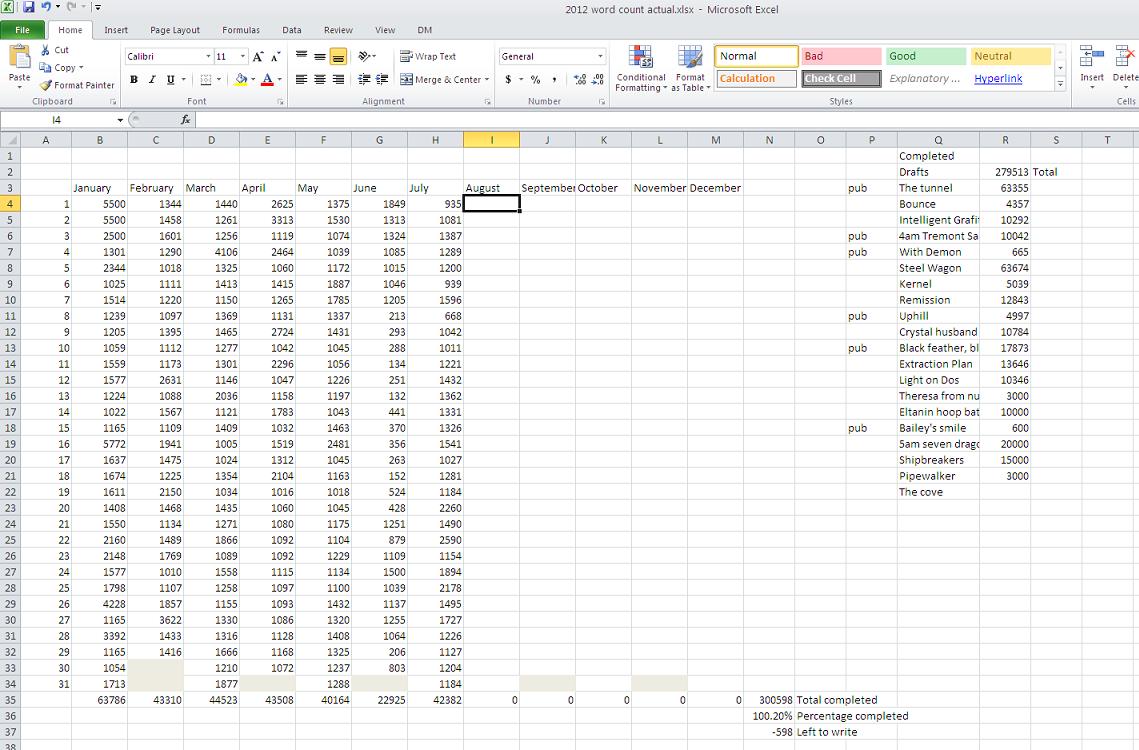
So I crossed the finish line. 300,000 words so far this year. Publishable? I hope. Some have been published already – some self, some with small presses, some have been accepted for upcoming publication and others are out with editors. As I wrote during my evening block of writing time I knew I would cross the line – I had 586 words to go. (This is how I’ve kept track of that – click to see the whole thing – a bunch of numbers I fill in each day and let Excel calculate to get totals and percentages. The bottom right corner gives me the total):

but I kind of lost track as I became more engaged with the current story. I ended up writing over 1100 words for the session – a reasonable day. In some ways I was pleased to see that I continued on without even realising… for a few days I’d been wondering if I would kick back and just congratulate myself and fall into the habit of watching bad TV. As I wrote a few days ago, I’ve reset the goal, and I think that will help keep me on track and motivated.

The spreadsheet above might seem a little OCD (I don’t scrub my hands, though I see elements of needing to know numbers in me), but it’s helped me have my eyes on the target. That percentage figure in the bottom corner ticking over has helped me focus. I’m keeping that – it’s at 100.20% now, and I’ll let it go on up to 150%, but I’ve added in another little ticker beside it for the August to December goal in the bottom corner:

That’s going to challenge me. I’ll have to stay at around an average of 1000 words a day. While December is clear, there are four tutoring deadlines between now and the end of November and two of those will be full-on: six weeks of pretty intense reading and feedback. I don’t expect to get through a lot of writing during those weeks. Still, I might play catch-up through December. The plan is to write The Deluge, the second part of The Hidden Dome trilogy, between the last day of tutoring and the last day of the year. That’ll be more like 2000 words a day.